﷽
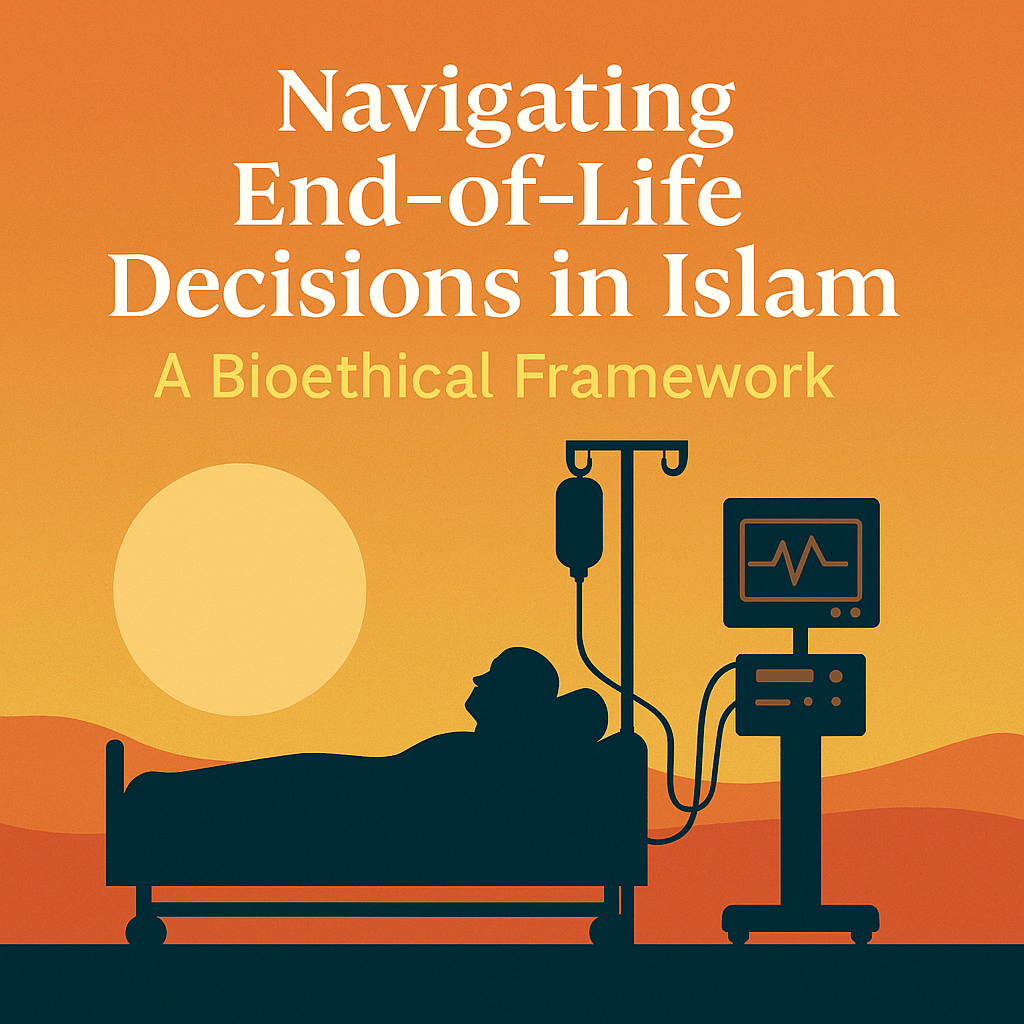
Navigating End-of-Life Decisions in Islam: A Bioethical Framework
By Dr. Rafaqat Rashid
Summary by Al Balagh Academy
Introduction
In an age of advanced medical technology, Muslim clinicians, patients, and families often face complex ethical dilemmas at the end of life. When is it permissible to withhold or withdraw life-sustaining treatment (LST)? How do Islamic scholars approach these decisions, and what should guide Muslim healthcare professionals? This blog summarizes a rigorous and practical framework proposed by Dr. Rafaqat Rashid, published in his scholarly chapter “An Islamic Bioethical Framework for Withholding and Withdrawing Life-Sustaining Treatment.”
The Problem with Current Fatwas
Many Islamic fatāwā (legal rulings) on end-of-life care lack clarity and practical detail. Terms like futility, terminal illness, and compounding harm are often vague and inconsistently applied. This has led to unnecessary suffering, delays in shifting to palliative care, and conflict between families and medical teams.
From “Futility” to “Religious Duty”
Rather than relying on subjective definitions of medical futility, Dr. Rashid argues for an Islamic ethico-legal framework based on religious duties and obligations. This framework considers both:
- Scientific Judgments – statistical and clinical outcomes
- Value Judgments – ethical and religious priorities
The key question becomes: Is it obligatory, optional, or prohibited to initiate or continue treatment?
Withholding vs. Withdrawing Treatment
Islam does not consider a moral distinction between withholding and withdrawing LST. What matters is the effectiveness and obligation tied to the treatment:
- If treatment is obligatory, withholding or withdrawing it is sinful.
- If treatment is optional, either action is permissible.
- If treatment causes more harm than benefit, continuing it may be prohibited.
Obligatory vs. Optional Treatments in Islam
In Islamic jurisprudence:
- Treatment is generally optional, not obligatory.
- It becomes obligatory when:
- The patient faces certain death without it.
- The treatment is proven (with dominant probability) to be life-saving.
Examples:
- Cardiopulmonary Resuscitation (CPR) is often optional due to low success rates.
- Artificial Nutrition and Hydration (ANH) is usually obligatory, unless shown to be ineffective or harmful.
- Mechanical Ventilation is case-dependent, often optional.

Practical Scenarios: Obligations in Action
| Treatment Outcome | Harm Level | Ruling |
|---|---|---|
| Certain to save life | Less harm | Obligatory |
| Certain to save life | Greater harm | Prohibited |
| Uncertain to save life | Less harm | Optional |
| Uncertain to save life | Greater harm | Prohibited |
This matrix allows Islamic scholars and medical professionals to navigate nuanced decisions practically and consistently.
Quantitative and Qualitative Evaluation of Life
Two core evaluations guide Islamic end-of-life decisions:
- Quantitative – Can treatment significantly prolong life?
- Qualitative – Will it improve quality of life or lead to meaningful existence?
Dr. Rashid outlines how both scientific accuracy and Islamic moral reasoning are essential for balanced decisions.
Conclusion
Dr. Rafaqat Rashid's Islamic bioethical framework provides a coherent, values-driven, and practical guide for navigating one of life’s most difficult moments: deciding when to let go. His work bridges Islamic legal tradition with contemporary medical ethics, helping families, scholars, and healthcare professionals uphold Islamic duties while minimizing unnecessary suffering.
📄 Read the full academic chapter here:
“An Islamic Bioethical Framework for Withholding and Withdrawing Life-Sustaining Treatment” by Dr. Rafaqat Rashid.
Please scroll down to view or download the full PDF.
🔗 Learn more about the author: Visit Dr. Rafāqat Rashid’s profile here to explore his academic background, publications, and teaching contributions.
🕌 Presented by: Al Balagh Academy


Explore Relevant Courses
Islam, End-of-Life and Palliative Care